Entrepreneurship, Unfiltered
What They Don’t Tell You Until It’s Too Late


By Dan Riley & Serena Huang
Most entrepreneurship content teaches people how to launch.
Very little teaches you how to survive what comes after.
This isn’t another article about finding an idea, building a pitch deck, or chasing growth at all costs. This is for the founder who is already carrying the weight of building something real. The one navigating uncertainty, pressure, reinvention, and the quiet questions nobody talks about publicly.
Part of what makes this conversation personal for both of us is that we come from very different journeys, but arrived at many of the same truths. Dan spent decades building businesses, navigating exits, leadership, and reinvention at scale. Serena built her career deep inside data, analytics, and the corporate world before stepping out to build something more human, purpose-driven, and authentic to who she is.
What we share is a belief that entrepreneurship is not just a business journey. It’s a human one.
And maybe that’s the rare combination we bring together: strategy and empathy, data and humanity, ambition and vulnerability, performance and heart. We’ve both seen success from the outside while privately navigating exhaustion, doubt, reinvention, and growth on the inside. That tension is real. And pretending otherwise helps nobody.
What entrepreneurship often hides behind polished founder stories and social media highlights is that building something meaningful changes you. It challenges your assumptions, your relationships, your identity, and sometimes your health. The lessons that matter most usually arrive after the excitement fades - when the reality of leadership and responsibility fully sets in.
Here are five truths entrepreneurs often learn later than they should.
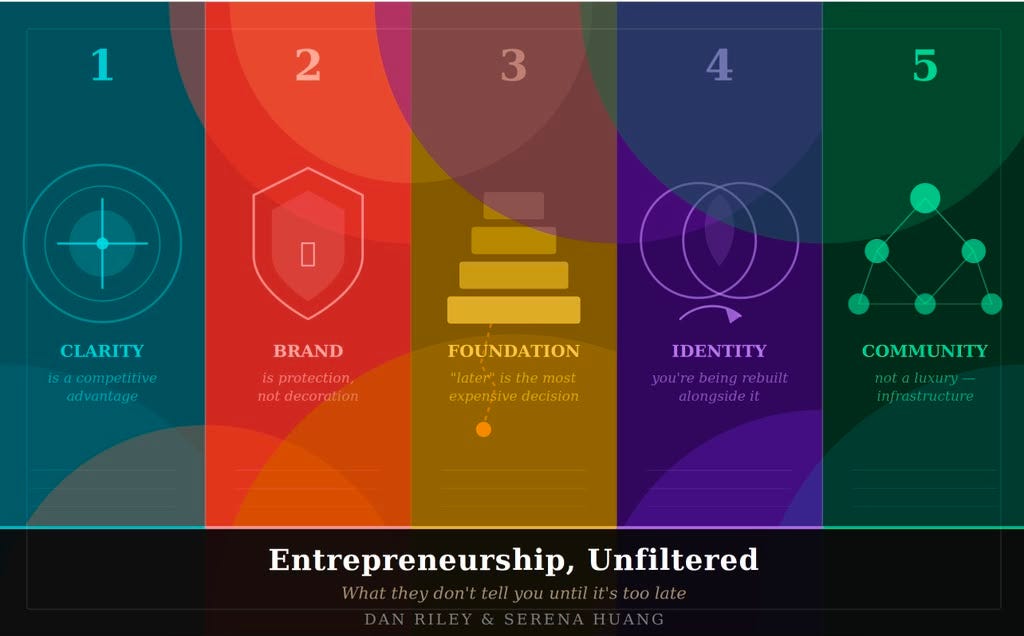
1. Clarity Is a Competitive Advantage
Most entrepreneurs begin with assumptions they mistake for certainty.
You think you know your customer. You think you understand the problem. You think the pricing model works. Then the market humbles you.
What looks like a strategy problem is often a clarity problem.
The founders who survive aren’t the ones who had everything figured out from day one. They’re the ones willing to continually challenge their own thinking and adapt quickly when reality changes.
Corporate environments often reward confidence and polished answers. Entrepreneurship rewards honesty. The market does not care how certain you sound. It only responds to whether you are solving something real.
The sooner you replace assumption with clarity, the faster you grow.
2. Your Brand Is More Than Marketing
Many founders treat branding like decoration: a logo, a website, a tagline.
But a real brand is trust.
It’s the story people tell themselves about you before they ever speak to you. It’s the reason someone takes your call, responds to your email, or believes you can solve their problem.
When growth slows, many entrepreneurs instinctively broaden their messaging to appeal to more people. Usually, that makes the problem worse.
Strong brands are built on conviction, not consensus.
People are drawn to clarity, perspective, and belief. The sharper your identity becomes, the more trust you create. A weak brand quietly shows up everywhere: slower pipelines, confusion in the market, missed opportunities, and conversations that never move forward.
Your brand is not just promotion. It’s protection.
3. The Things You Ignore Early Become Expensive Later
The contract you skimmed.
The financial structure you delayed revisiting.
The legal details you planned to “handle later.”
Most founders have a story about something small they overlooked early that eventually became a major problem.
The challenge is that foundational work rarely feels urgent in the beginning. It feels like overhead. There is always something more exciting competing for attention: product, fundraising, sales, growth.
But eventually, “later” arrives.
The entrepreneurs who build lasting companies understand that protecting the foundation is not bureaucracy - it’s strategy. Sustainable businesses are rarely built on shortcuts that go unaddressed.
4. Entrepreneurship Changes More Than Your Work
Most people expect entrepreneurship to challenge their business skills. Fewer expect it to challenge their identity.
When founders talk about uncertainty, they’re often talking about more than revenue, customers, or growth. They’re also navigating a deeper question: who am I when there isn’t a title, organization, or career path defining success for me?
Entrepreneurship has a way of exposing assumptions we didn’t realize we were carrying. Assumptions about achievement, security, recognition, and what it means to be successful.
That’s part of why the journey can feel both energizing and exhausting. You’re not just building a business. You’re constantly adapting alongside it.
The founders who thrive over the long term are rarely the ones who avoid change. They’re the ones willing to evolve with it. They stay curious, challenge their own thinking, and continue learning even as the business grows.
In many ways, entrepreneurship is one of the greatest personal development journeys disguised as a professional one.
5. Entrepreneurship Can Be Incredibly Lonely
This is the part very few people talk about honestly.
You can be surrounded by admiration, attention, and opportunity and still feel deeply alone in what you are carrying.
The loneliness of entrepreneurship is not solved by more networking events or LinkedIn connections. It comes from feeling like very few people truly understand the weight of the decisions, risks, and uncertainty you live with every day.
Founders often believe everyone else has things figured out better than they do. In reality, many are carrying the exact same fears privately.
That’s why real community matters.
Not performative networking. Not surface-level relationships. Real rooms where people can speak honestly about failure, pressure, uncertainty, and growth without pretending to have all the answers.
Community is not a luxury for entrepreneurs. It’s infrastructure.
The Challenge
Stop optimizing for the appearance of momentum.
Start building from truth.
Get honest about what you’re building, who it’s for, and what actually matters. Protect your foundation. Protect your energy. Build a brand rooted in belief. Surround yourself with people who allow honesty instead of performance.
The founders who build lasting companies are rarely the ones who appear the most polished. They are the ones willing to confront reality the fastest and grow from it.
The entrepreneurs who succeed are not always the ones with the best ideas.
Often, they’re the ones willing to tell themselves the truth first.
And maybe that’s the deeper lesson underneath all of this: entrepreneurship is not simply about building companies. It’s about building yourself while you build something bigger than yourself.
That journey changes you.
It humbles you. Sharpens you. Exhausts you. Inspires you. And if you allow it, it can reconnect you to what actually matters: purpose, people, contribution, and truth.
We don’t believe founders need more performance, more pretending, or more curated perfection. We believe they need more honesty. More meaningful conversation. More spaces where ambition and humanity can exist together.
Because the future of entrepreneurship will not belong to the loudest founders.
It will belong to the most grounded, the most self-aware, and the most human.
About the Authors
Dan Riley is the Co-Founder of RADICL, a serial entrepreneur, keynote speaker, and investor based in Minneapolis. Dan is a recognized voice at the intersection of AI, leadership, culture, and the future of work. His work focuses on building more human-centered organizations in an increasingly AI-native world.
Serena Huang is Founder of Data With Serena, an AI transformation advisory helping enterprises turn AI strategy into adoption, capability, and measurable business impact. She previously led People Analytics and AI at PayPal and held senior roles across GE and Kraft Heinz, scaling initiatives from pilot to enterprise deployment. She is the author of The Inclusion Equation (Wiley, 2025) and partners with C-suite leaders on making AI operational inside large organizations.
We’re exploring the idea of creating a community and conversation series for founders, entrepreneurs, and business leaders who want a more honest space to learn, connect, and grow together.
Less performative networking. More real conversations.
If that sounds interesting to you, we’d love to hear from you.
 | A guest post by
|
Point 4 is the one nobody fully prepares for. You can stress-test a business model but you can't simulate who you are on the other side of the clarity that building forces. Most founders are navigating a quiet identity rebuild alongside the visible one — and that second process is usually the harder of the two.
Yes! Building a business from the ground up changes us as human beings. This is so often lost in the conversation of scale and growth and what's next and that also contributes to the loneliness. "Who am I now that I have built this?" is rarely asked and leads to founders never quite understanding that their business needs to evolve as they evolve. It all moves so much more smoothly when we understand from the jump that we are human and evolve and our businesses must evolve with us.